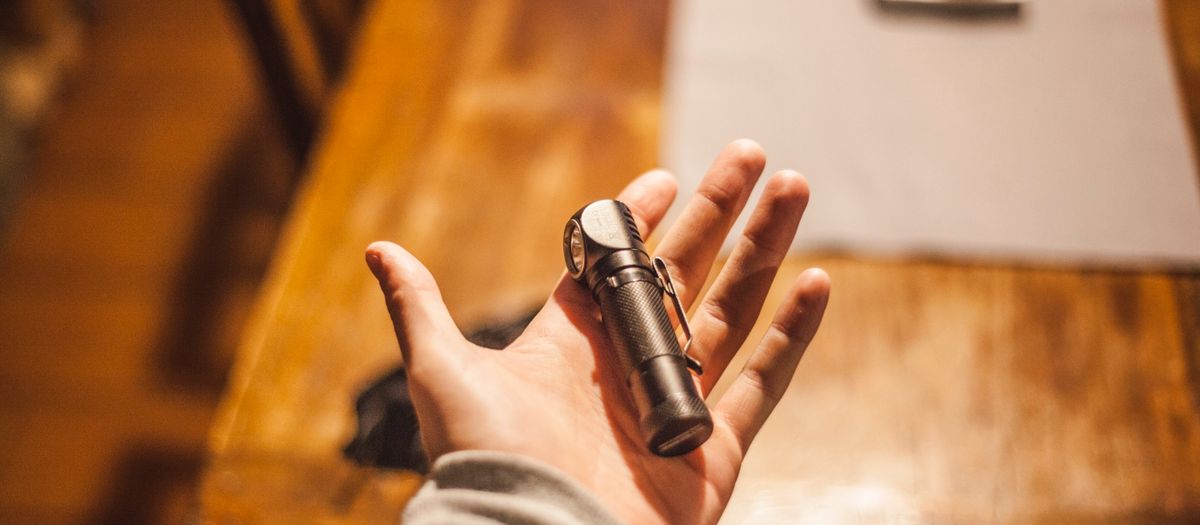
If you opened my pocket on any given day for the last several years, you’d find the same thing: a single-18650 EDC light with a pocket clip. Not the brightest light I own, not the smallest. It’s the one that gets the trade-offs right for the way I actually live. Here’s why I keep coming back to it.
What “single-18650” even means
The 18650 is a lithium-ion cell — 18mm across, 65mm long, the round 0 on the end. It’s the cell that powered the first generation of laptop batteries, and it’s become the backbone of good flashlights for one simple reason: it holds a lot of energy in a size that still fits a pocket. A “single-18650” light runs on exactly one of these cells.
That one cell is the quiet hero. It’s why the light can hold a real, regulated output for a couple of hours instead of flashing bright and dying. It’s enough energy to do serious work, in a tube small enough to clip to a jeans pocket and forget about.
Why it’s the daily-carry sweet spot
I think about an EDC light as a balance of four things: output, runtime, size, and battery sanity. The single-18650 is the format that refuses to be bad at any of them.
- Output. A single 18650 can comfortably feed a regulated 1,000-ish lumen output — far more than I need for everyday tasks, with headroom for the rare “light up the whole yard” moment.
- Runtime. This is the big one. A good single-18650 light will hold a usable level for a couple of hours on the FL-1 runtime-to-10% figure, and stretch to many hours on a lower setting. My old keychain lights died in minutes. This one outlasts the job.
- Size. It’s a tube about as long as my palm and about as thick as a marker. It clips into a pocket, rides there all day, and I forget it’s there until I reach for it. Smaller lights exist, but they trade away the runtime I just talked about.
- Battery sanity. One cell. One charger. When it’s flat I swap in a charged spare or top it up over USB-C. No proprietary pack, no hunting for an oddball size.
Compare that to the alternatives and you see why it wins for carry. A keychain AAA light is tiny but dim and short-lived. A twin-21700 monster throws huge output but it’s a brick in your pocket. The single 18650 sits right in the middle, and the middle is exactly where daily carry lives.
The two things I actually value about it
Past the spec sheet, two real-world habits keep me on this format.
Spare cells are trivial. I keep a charged 18650 in a small cell case (loose cells never ride against keys or coins — that’s a factual safety habit, not a preference). When the light runs low, thirty seconds and it’s full again. For a long night out, a fresh cell is effectively a full second tank in my pocket. A built-in-battery light can’t do that — when it’s flat, you’re tethered to a cable.
Charging is sane. My carry light takes USB-C right on the body, so most days I just top it off like a phone. But because it’s a swappable 18650, I’m never stuck — if the port ever failed, I drop in a charged cell and keep going. That redundancy is the whole reason swappable cells still matter to me.
The safety part, plainly
Because it’s a lithium-ion cell, there are a few non-negotiable habits. Charge the 18650 only on a charger rated for that cell. Never charge a damaged or swollen cell. Never carry a loose cell where it can short against keys or coins — use a cell case. Follow the cell and charger manufacturer’s instructions, and use the maker’s recommended cell and charger. None of that is hard; it’s just the price of carrying a cell that holds this much energy in your pocket, and it’s worth it.
Would I tell you to carry one?
For most people who want one light to do everything — pocket, work, dog-walks, the glovebox emergency — yes. The single-18650 EDC light is the format I’d hand a friend without a second thought. It’s bright enough, it lasts, it fits, and the battery story is simple.
If you want to see the specific lights that nail this format — the ones with honest FL-1 figures, a good clip and a sane UI — that’s exactly what the best EDC flashlights guide is for. It’s the format that’s been in my pocket for years, and I don’t see that changing.